


Coffee, for millions of us, is the essential start to the day. It’s a ritual, a comfort, and the driving force behind a global business. But the very thing we love so much is in danger.
Climate change is already reshaping the world’s coffee-growing regions, making it harder for farmers to produce the beans we depend on.
The perfect conditions that have allowed coffee to thrive for centuries are disappearing, and with them, the livelihoods of millions of people.
This isn’t just about a potential change in flavor or a price increase; it’s about a global crisis that threatens the future of our morning cup.
The question isn’t if climate change will affect coffee, but how, and what we can do to save it before it’s too late.
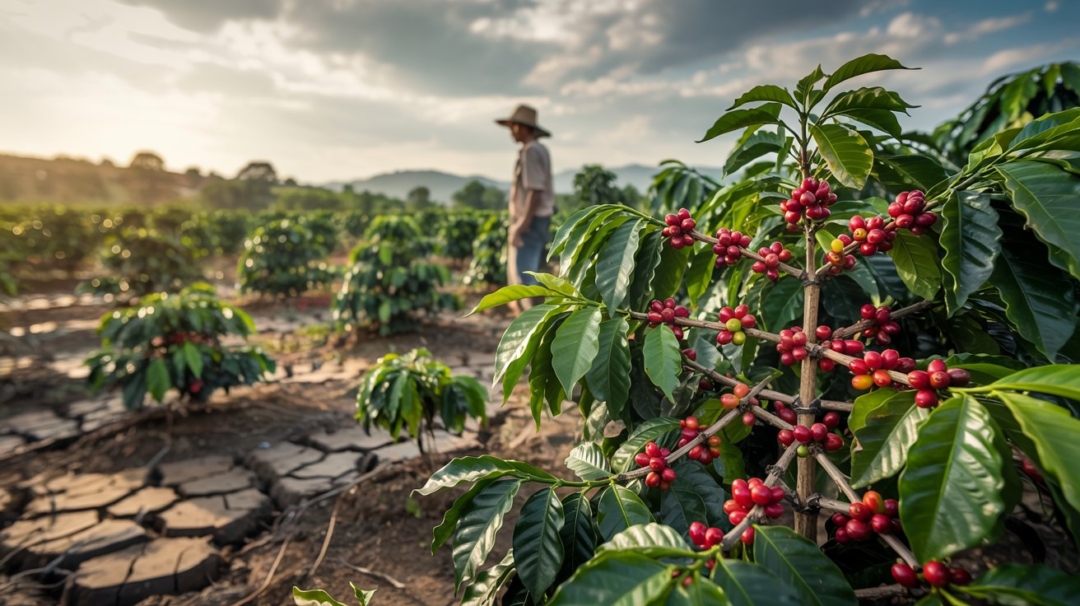
A Shrinking World for Coffee Beans
Coffee plants, especially the highly prized Arabica Coffee species, are picky. They thrive in a narrow band of climate conditions, often referred to as the “Bean Belt.” This belt is a loop around the planet between the Tropics of Cancer and Capricorn.
Arabica coffee prefers mild temperatures between 18°C and 22°C (64°F to 72°F) and consistent rainfall. However, these ideal conditions are shifting as global temperatures rise. The change is pushing farmers to higher altitudes where it’s cooler.
Climate Change and the Future of Coffee
A new study predicts that by the year 2050, the total land area suitable for growing coffee will decrease by as much as 50%.
The world’s top coffee producers, including Brazil, Vietnam, Colombia, and Indonesia, are projected to lose a significant portion of their best growing land.
Brazil’s extensive low-elevation areas are perfect for Arabica production. The regions are likely to suffer substantial losses as temperatures increase. Colombia also specializes in the more sensitive Arabica species. It could be hit especially hard.
On the flip side, some countries that have historically not been major coffee producers, such as the United States, Argentina, and China. These countries may see an increase in suitable land. This could reshape the entire global coffee landscape.
A Complex Web of Threats Beyond Temperature
Climate change isn’t just about rising heat. It’s a complex issue that creates a domino effect of problems for coffee farming.
Unpredictable Weather Patterns
Coffee production depends on stable weather, but climate change is making rainfall patterns erratic. Farmers now face longer, more severe droughts that dehydrate plants and damage soil quality.
These droughts are often followed by unpredictable, heavy rains. These changes can cause devastating floods and landslides.
These environmental elements destroy crops and valuable infrastructure like drying stations. Moreover, it makes it impossible for farmers to get their beans to market.
The unpredictability also messes with the maturation of coffee cherries, spoiling entire harvests.
The Rise of Pests and Diseases
Warmer and wetter climates create perfect breeding grounds for pests and diseases that harm coffee plants. One of the most destructive is the coffee borer beetle, which burrows into coffee cherries and destroys the beans inside.
Another major threat is coffee leaf rust, a fungal disease that can wipe out entire crops. In Central America, a state of emergency was declared after a 2012-2013 outbreak of coffee leaf rust. This condition destroyed more than half of the planted coffee and put hundreds of thousands of people out of work.
These threats not only reduce yields but also force farmers to spend more on pesticides, increasing their costs and making it harder to earn a living.
The Human Cost of Climate Change
The effects of climate change are not just about bean quality. They are deeply personal. Over 125 million people globally depend on the coffee industry for their survival.
The majority of these are small-scale farmers in developing countries who lack the resources to combat these changes. When a crop fails, it’s not just a loss of a product; it’s a direct blow to a family’s income.
For these communities, coffee farming is often their sole source of income. The economic impact can be devastating, like a “giant factory moving out of town,” as one expert described it.
While some communities might be able to switch to other crops like avocados or cashews, many will be left with no immediate alternative.
It will impact not only local economies but national ones as well, as many countries rely on coffee exports.
What’s Being Done to Save Coffee?
The crisis is real, but the good news is that the coffee industry is not sitting by. Farmers, researchers, and major coffee companies are all working on solutions.
- Adaptive Farming:
Some farmers are already moving to higher altitudes to find cooler climates. Others are using techniques like agroforestry, planting their coffee plants under the shade of other trees to protect them from heat and soil erosion.
- Breeding New Varieties:
Scientists are racing against time to develop new, climate-resilient Arabica hybrids. These new varieties are bred to be more tolerant of higher temperatures and more resistant to pests and diseases, giving farmers a fighting chance against a changing climate.
- Industry-Wide Cooperation:
Large companies like Starbucks and Nestlé are investing millions in programs that provide direct training and resources to farmers. This support helps them adopt more efficient and sustainable growing practices.
However, these solutions have limitations. It can take years to perfect new plant varieties, and they may not be able to keep up with the fast pace of climate change. Ultimately, the fate of coffee is tied to the global effort to reduce carbon emissions and prevent further warming of our planet.
The next time you enjoy your cup of coffee, remember the complex journey it took from a small farm to your mug. We can all play a part in helping farmers adapt by supporting sustainable and ethically sourced coffee. This way, we can ensure that our favorite drink has a future.